
May 9, 2022 | Energy Efficiency
Tip 1: Plant shade trees to cool your home
The summer sun hits your home’s walls, windows and roof. This heats up your house, causing your A/C to work overtime. Planting trees around your home can provide shade, giving your air conditioning unit a much-needed break.
Tip for tip 1:
To the south and west of your home, plant trees that shade your walls, windows and at least 20% of your roof. Plant deciduous trees that grow 25‒40 feet tall when mature for the best results. Plant the trees with their trunks at least 15‒20 feet away from your walls, and make sure there are no power lines or other obstructions nearby.
Tip 2: Use ground cover in place of grass or turf
Adding plants to your yard can help keep it cool. Replace part of your lawn with lush ground cover. Water will evaporate off the leaves of the plants, cooling the air around your home.
Tip for tip 2:
Choose low, slow-growing plants that do not require much water or fertilizer to grow. Keep plants 1‒2 feet away from house foundations to avoid a buildup of moisture or pests.
Tip 3: Plant shrubs to better shade your air conditioner’s condenser
Creating shade for your air conditioner can cool down the air around it. The result? Your A/C unit doesn’t have to work as hard to cool your air before sending it into your house.
Tip for tip 3:
Plant tall, narrow shrubs (with a height of around 5‒8 feet). Leave 3‒5 feet of space between the shrubs and the A/C unit for better airflow. And don’t forget to leave room for airflow around the A/C heat exhaust vent.
Tip 4: Plant a windbreak
Planting a windbreak near your home will create an area of still air next to your house. This will prevent drafts and increase your home’s energy efficiency.
Tip for tip 4:
Decide which direction the wind blows most frequently on your home. On that side, plant an unbroken row of evergreen trees that won’t lose their foliage in the winter while blocking the wind year-round. Make sure the edge of the trees is about 5 feet away from your exterior walls. The row of trees should also extend beyond your walls on both sides.
For more energy efficiency tips and ways to save, visit savewithppl.com.

Feb 25, 2022 | Bill Help
If you’re struggling to pay or even facing a shut-off, we have programs and payment agreements to help you catch up.
Programs for income-eligible customers
LIHEAP: Apply for free federal grants to help with your home heating bills and emergencies.
OnTrack: Get a lower fixed monthly payment. If you have a past-due balance, you’ll also receive debt forgiveness.
Emergency Rental Assistance Program (ERAP): If you rent your home and your income was impacted by the pandemic, you may qualify for free grants to help with your rent and utility bills. Many of our customers have already taken advantage of this federal program. In fact, PPL Electric customers have claimed more than $6 million in ERAP funds so far, and there are still millions of dollars remaining in the program.
Pennsylvania Homeowner Assistance Fund (PAHAF): If you own a home and can show that your income has gone down or your living expenses have gone up as a result of the pandemic, you may be eligible for free money to help with your mortgage and utility bills.
Operation HELP: Apply for a cash grant to help with home heating bills.
CARES: If you’re experiencing a temporary hardship, such as illness or injury, you may qualify for protection from shut-off.
WRAP: See if you qualify for free energy efficiency products to help save energy and money.
Programs for all customers
Payment agreements: We can set you up with an agreement to pay down your bill over time.
Budget billing: We’ll average your electric use over the entire year so your bill amount will be more predictable.
Not sure where to start?
Sign into your online profile at pplelectric.com and click “Get Help Paying.” We’ll ask you a few questions about your household and financial information and recommend the programs that will benefit your family most.
Nov 25, 2014 | Energy Efficiency
Last winter, many customers on variable-rate plans for their generation supply faced high bills, resulting from a combination of high usage during the prolonged cold weather and volatile market prices.
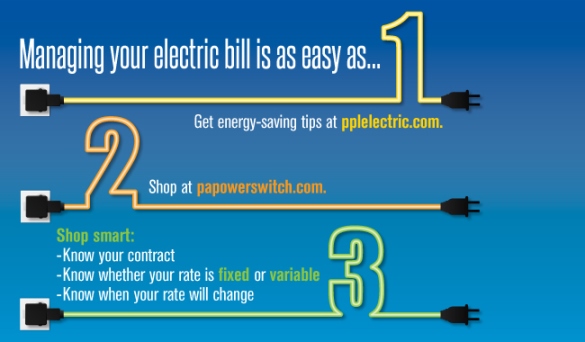
We suggest a three-step plan to help customers avoid paying more than they have to for electricity:
1. Use energy wisely
We have many low-cost and no-cost tips to help you save energy. They include turning the thermostat down, if you can. Heating accounts for more than 30 percent of an average home’s energy bill. Turning the thermostat down about 1 degree saves about 2 percent on your heating bill, while turning it down 5 degrees saves about 10 percent. Also, seal your house against drafts, and have your ductwork checked for air leaks.
2. Shop for electricity
Shopping for everything from groceries to gasoline is part of almost every family’s routine. So why not shop for electricity, too? The Pennsylvania Public Utility Commission has a website that makes shopping easy: PAPowerSwitch.com.
3. Shop smart
Customers have two choices when they shop for their electricity: fixed rate and variable rate. If you have a variable rate, it means the price you pay per kilowatt-hour can change anytime, based on factors like weather and market conditions. A fixed-rate plan offers pricing stability for a defined period of time. There are many fixed-rate offers below PPL Electric Utilities’ price to compare — the rate PPL Electric Utilities charges customers who don’t shop.
Even if you’re already on a fixed-rate plan, it’s a good idea to check the terms and expiration date of your supply agreement. Sometimes fixed-rate plans automatically shift to variable-rate plans when they expire.
As with any purchase you make, it’s always good to double-check what you’re buying, and know the terms of your energy contract and the price you’ll pay this winter.
No matter where you buy your electricity, it will still be delivered safely and reliably by PPL Electric Utilities.
Aug 18, 2014 | Energy Efficiency
Relax and kick back – you’re going on vacation! But don’t take a vacation from saving energy at home. While you’re lying on a beach or exploring a new city, your empty house is still using energy.
Here are some tips to help you save energy while you’re away:
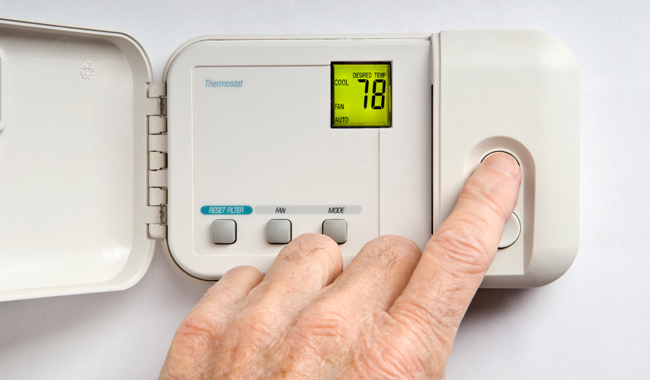
1. Change your thermostat: Set the thermostat temperature much higher than usual. No need to spend money to cool a home when you won’t be there, unless you have pets that will be staying behind.
2. Adjust your water heater: Turn down your water heater to “vacation” or “pilot” mode. Water heating can account for up to 25 percent of the energy consumed in your home, and a large percentage of this cost is to have hot water ready to use, according to ENERGY STAR.
3. Unplug your electronics: Even when your electronics and appliances are turned off, they still use small amounts of power. Unplug your computer, TVs, video game system, coffee maker, etc. Or if these items are plugged into Smart Strips, you can turn off the strip to power down everything at once.
4. Use automated timers: Set an automatic timer on a few lights instead of leaving a light turned on. Consider installing motion-activated lights outside your home. These lights turn on when there is movement near your home.
5. Be shady: Keep your window shades closed. Draw your curtains and close your blinds to shield the air inside your house from the sun. When you return home, let in the fresh air!
6. Turn off fans: Remember, fans cool people, not rooms. When you’re not home, be sure to turn off the fans.