
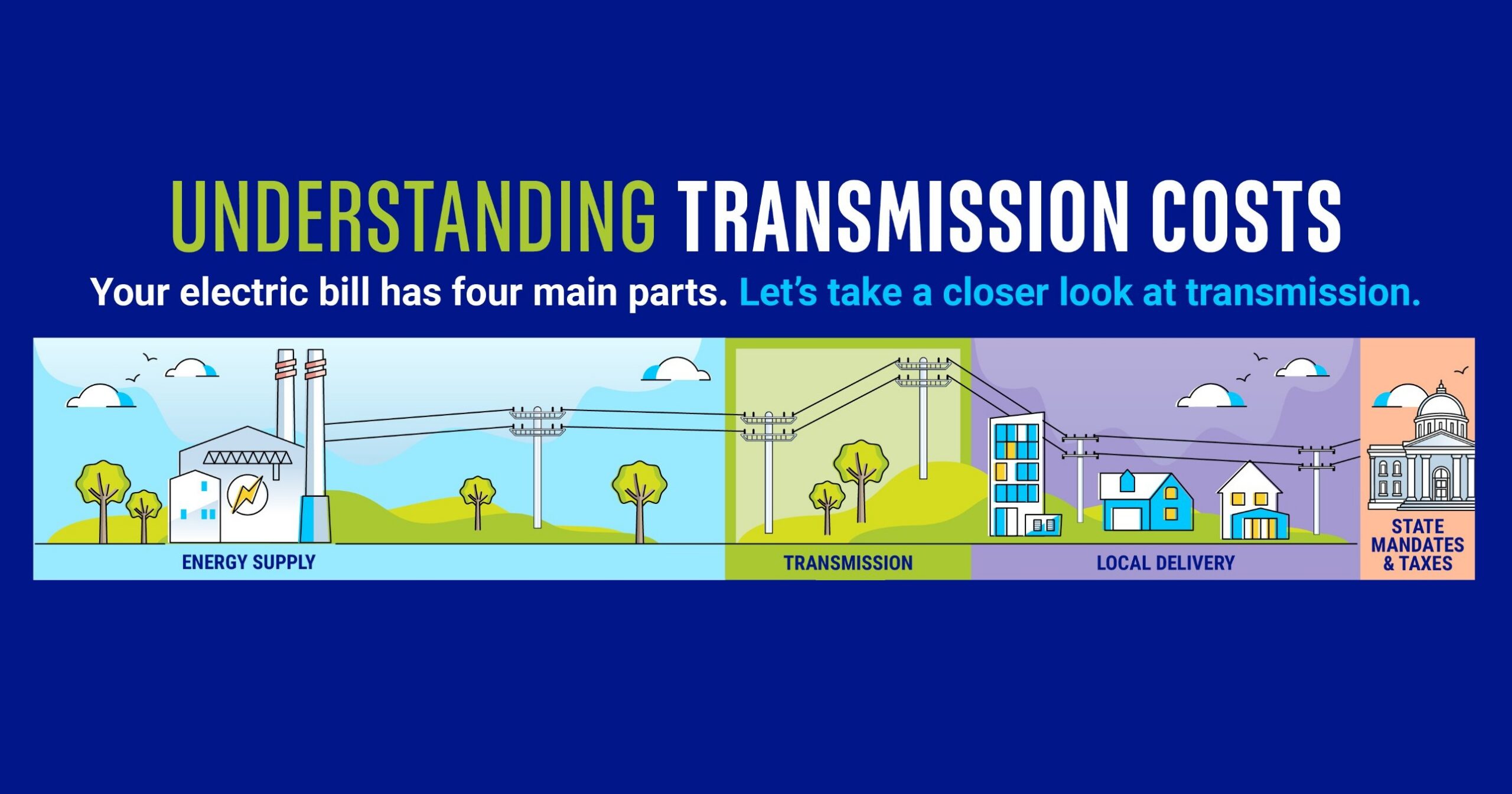
Electric bills have several different components, and understanding what goes into each one can be complicated. We get it.
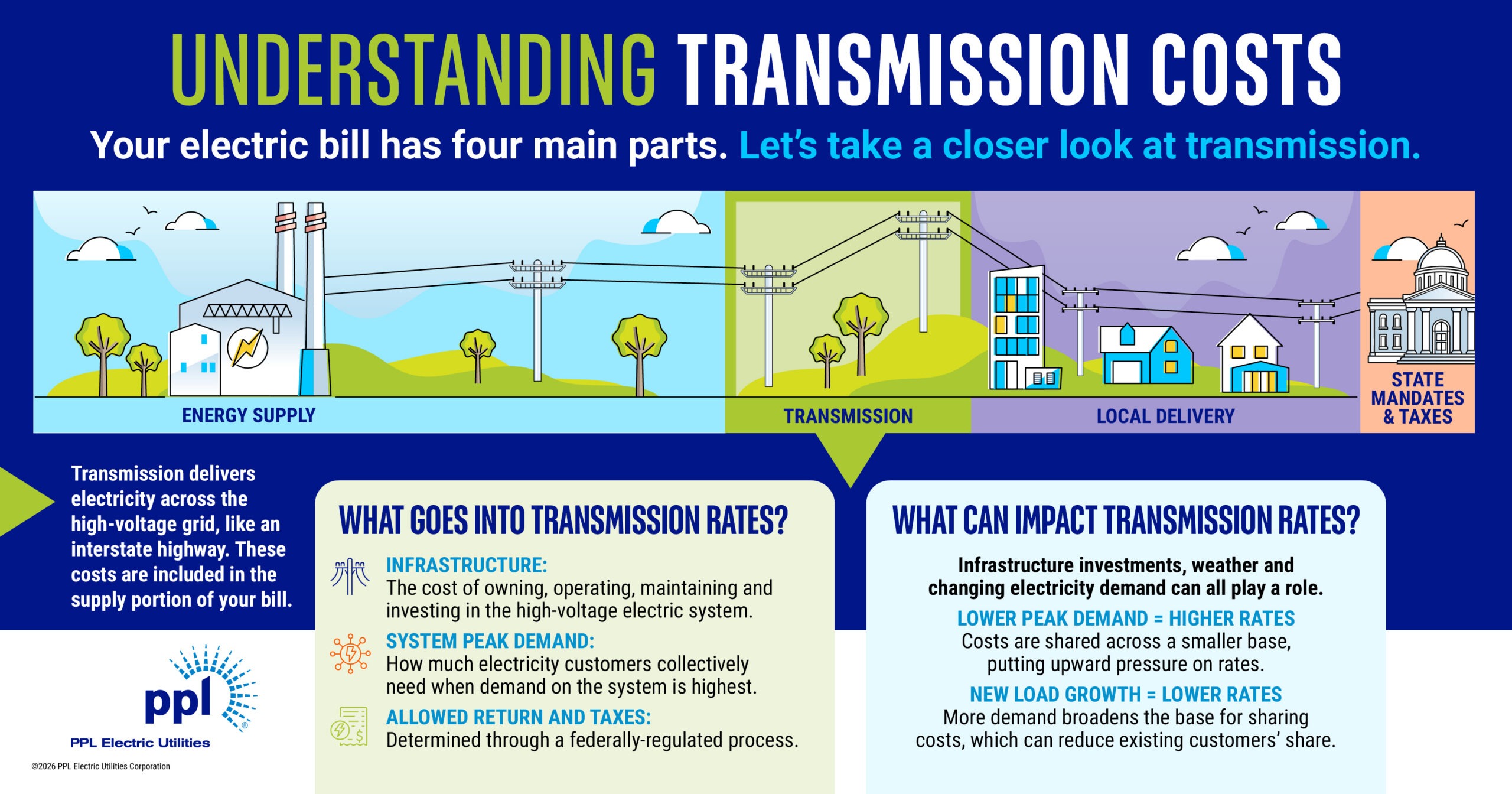
That’s why we’ve been helping customers understand where each dollar of their electric bill goes. One part of that bill is transmission, which helps pay for moving electricity across the high-voltage electric system.
Here’s a closer look at what transmission costs cover, why they can change and how new large energy users can affect how those costs are shared.
What is the transmission system?
Think of the transmission system as the interstate highway for electricity. It moves large amounts of electricity over long distances before it reaches the local distribution system that delivers power to homes and businesses.
Transmission costs are included in the supply portion of customers’ electric bills. For customers on PPL Electric’s default supply, transmission is included as one component of the Price to Compare. Customers who choose a competitive energy supplier also pay transmission costs to their competitive energy supplier through the supply portion of their bill. No matter what, transmission costs are established through federally regulated processes.
What goes into transmission costs and why do they change?
Transmission rates help recover the costs of owning, operating, maintaining and investing in the high-voltage electric system.
But infrastructure costs aren’t the only factor. How those costs are shared also matters.
One important factor is how much electricity customers collectively need when demand on the system is highest, known as peak demand. Peak demand can vary depending on weather, the total number of customers served and the number of large energy users.
That creates an important dynamic:
- When overall peak demand is lower, transmission costs are spread across less megawatts of electricity, which can put upward pressure on transmission rates.
- As additional load connects and contributes to the peak demand, those costs can be allocated across a larger base of electricity use, which can put downward pressure on the share being paid by existing, non-large load customers.
Where do data centers and other large energy users fit?
There are two different concepts that are important to understand: how transmission costs are shared and who pays for infrastructure needed to serve a new large-load customer.
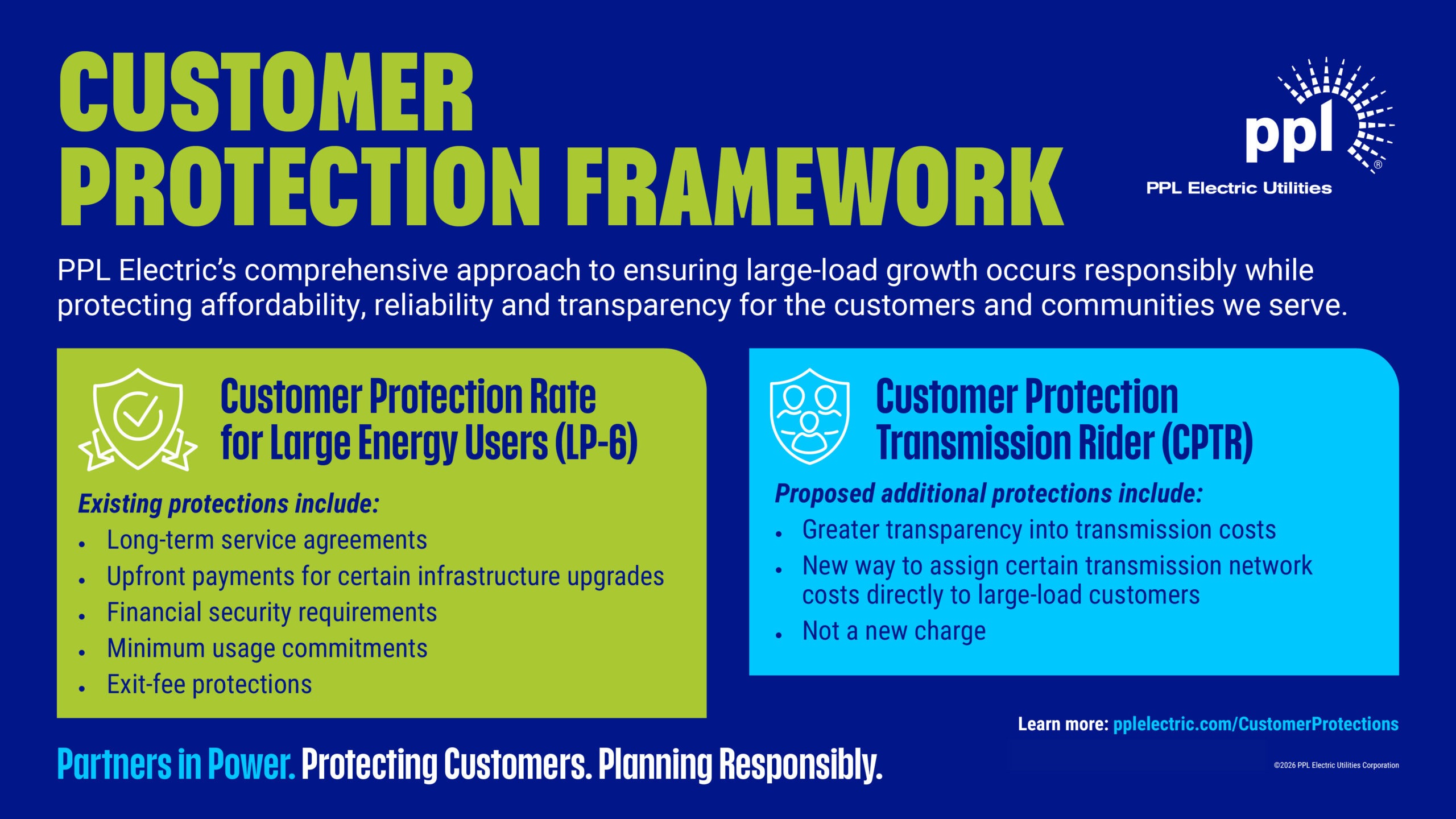
PPL Electric already has protections in place for qualifying large-load customers through its LP-6 rate. Large-load customers are responsible for infrastructure needed specifically to serve their projects and are subject to financial security, minimum usage commitments and exit protections intended to reduce the financial risk to other customers if a project does not develop as planned.
And we’ve proposed an additional layer of protection.
Some transmission investments associated with connecting new large energy users have broader benefits and can become part of the electric system that serves everyone. Under the traditional way those costs are recovered, some costs can ultimately be shared across customers.
That’s why we proposed a Customer Protection Transmission Rider, which would allow us to directly assign certain transmission network costs associated with large-load development to our large-load customer class. It would also make transmission costs more visible on customer bills, giving customers greater transparency into what they are paying for.
At the same time, when new large-load customers actually connect and contribute to system peak demand, they are expected to take on a larger share of transmission system costs based on their electricity use. That can reduce the share allocated to existing customers, although the actual impact will vary based on transmission costs, system peak, and the timing and level of new load.
Our focus: protecting customers
Pennsylvania’s energy needs are changing, but our responsibility to our customers is not.
We believe growth should occur responsibly, with strong protections to help ensure existing customers aren’t left paying costs that should appropriately be borne by new large energy users.
That’s why we’re working to make transmission costs easier to understand, strengthen protections and give customers greater transparency into how the changing energy landscape can affect their bills.
Thank you for caring.
Are you able to go on a payment plan if needed and will my bill be cheaper. What happened if there is no energy. Can you change back at anytime. Thank you
Good afternoon, Sophia. Payment plans only help to protect your account while you pay off a past due balance. If you need help lowering your payments here are some options that can help.
If you have a web profile set up for your account, please sign in and view your daily & hourly usage online under http://www.pplelectric.com/analyze. You will see what time of day your usage is highest and can make lifestyle adjustments to lower your usage.
Review tips to save energy and money under http://www.savewithppl.com. We also offer a FREE Virtual Home Energy Assessment that includes a phone consultation with a trained Energy Advisor, energy efficiency recommendations specific to your home and a free personalized energy savings kit. For more information and to set up an appointment, visit http://www.pplelectric.com/virtualassessment.
Apply for assistance programs online under http://www.pplelectric.com/billhelp. Read more about lowering your bill by shopping for a generation supplier at a lower rate under http://www.pplelectric.com/shopping.
We have an Energy Education team available weekdays 8am-5pm to discuss your usage concerns at 1-800-342-5775 (say Energy Education). Thank you.
Thank you for providing this information on a simple platform easy to understand and hopefully customers will read.
Some one is coming into Carbondale area claiming affiliation and trying to offer solar panels. Hé had no affixed ID but a QR code on his phone. This is concerning.
Good afternoon, Leslie. Companies such as suppliers and solar installers should not be telling customers that they are part of PPL. They may say that they work with us, but if they try to mislead customers that is against Public Utility Commission rules. If you feel they are not abiding by these guidelines you may contact the Public Utility Commission at 1-800-692-7380.
It is imperative that all PPL customers read and understand the transmission cost involved, the process of new transmission service is extremely expensive, ROW cost tower cost and installation, the materials, labor cost, are major factors but not so obvious cost of insurance, financing have to be taken into account, it’s not all fun and games.
Your rates are OUTRAGEOUS period. I lived in Texas for 27 years and returned home to the Northeast. I never paid a transmission rate in Texas for my electric bill. It was non-existent. My electric bill nearly tripled moving back east. I live in the same size home with the same electric consumption. In my first year of living here, I compared my old TX electric bills and usage to my PA electric bills and was astonished. The overcharging in PA should be a CRIME.
Here are some options that can help lower your bills:
If you have a web profile set up for your account, please sign in and view your daily & hourly usage online under http://www.pplelectric.com/analyze. You will see what time of day your usage is highest and can make lifestyle adjustments to lower your usage.
Review tips to save energy and money under http://www.savewithppl.com. We also offer a FREE Virtual Home Energy Assessment that includes a phone consultation with a trained Energy Advisor, energy efficiency recommendations specific to your home and a free personalized energy savings kit. For more information and to set up an appointment, visit http://www.pplelectric.com/virtualassessment.
Apply for assistance programs online under http://www.pplelectric.com/billhelp. Read more about lowering your bill by shopping for a generation supplier at a lower rate under http://www.pplelectric.com/shopping.
We have an Energy Education team available weekdays 8am-5pm to discuss your usage concerns at 1-800-342-5775 (say Energy Education). Thank you.
I apprciate PPL attempting to protect customers by creating the LP-6 rate. I have also received rebates for trying to improve electricity use in my home. Infrastructure has been a problem for decades. What guarantees are there and which governments’ depts will make sure power plants’ transmission income will actually be put toward infrastructure improvements. How is Constellation / Crane Clean Energy going to protect TMI unit 1 reactor from being hacked by enemy states? The fact they are a year ahead of schedule should NOT be reassuring. What will prevent directly connected facilities like Amazon in Berwick from letting its AI go rogue as others have done recently.
So by understanding the transmission cost and providing transparency in how its distributed will not really lower my “share” of this cost.
Data centers and whoever needs high use energy needs to pay the cost to upgrade or create new transmissions lines. Its seems the current system didn’t increase until these data centers came into play.
As a retired PPL employee, I find it hard to fathom how grid reliability can be maintained when the proposed loads for data centers approach the size of power plants. In that light, would data centers almost certainly have to provide their own power or is the plan to shed their load during a system disturbance?
Providing enough robustness and redundancy for them to ride through disturbances seems impractical.