Jul 24, 2020 | Safety and Security
Installing a fence or mailbox post? Building an addition? Starting a big landscaping project?
There’s one thing you always need to do before you or your contractor start digging.
Call 8-1-1 for the Pennsylvania One Call System to help prevent contact with underground powerlines or other utilities.
The call ensures that a crew comes out to mark all the areas with spray paint, flags, or other identifiers where underground utilities exist, whether they be power lines, water lines, sewer lines or gas lines.
State law requires an 811 call before digging with any power equipment in Pennsylvania. That call must be placed three business days prior to a dig.
We recommend that an 811 call be placed for any digging activity, whether it is an old-fashioned shovel or powered machinery, to ensure the safety of everyone involved.
Each year, we receive reports of about 60 to 75 digging incidents in which the person doing the digging failed to call 811. The Pennsylvania Public Utility Commission says that there are about 6,000 hits each year on underground utilities in the state overall.
If there’s construction going on in your neighborhood involving digging and you’re unsure whether an 811 call was placed, it never hurts to make that call just to be safe.
When calling 811, be prepared to share the following information:
- The county and municipality in which the planned dig is located.
- The street name and address.
- The nearest intersecting/cross street to the address.
- Details of the dig site, including the area of the property where excavation will occur and what kind of work is being done.
- When the project is scheduled to take place.
- The name of the company doing the work (if applicable).
For more information on safe digging, visit pa1call.org.
Jul 10, 2020 | Reliability
The world is changing fast and the electric power grid is no exception.
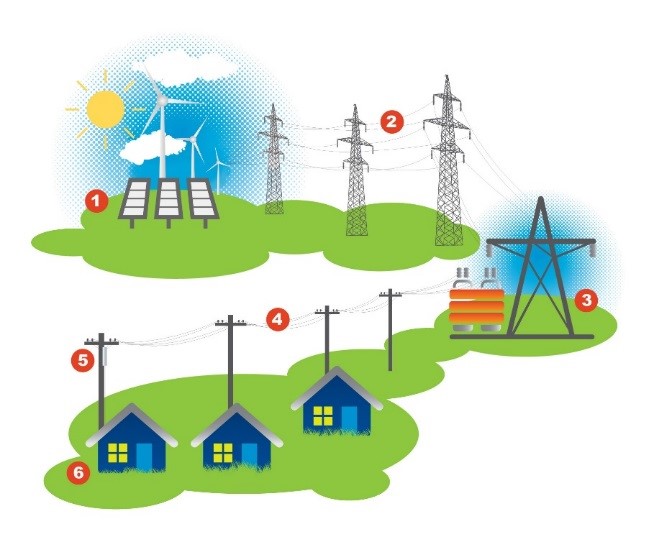
For the longest time, power flowed just one way: from the power plants, across transmission lines, to substations and finally through distribution lines to homes and businesses.
Now, with more renewable energy like solar and wind, that power is starting to flow both ways, with renewable power coming onto the grid.
Renewable energy is right for our customers, community and world. That’s why we’ve invested in the future to make sure the power grid is ready.
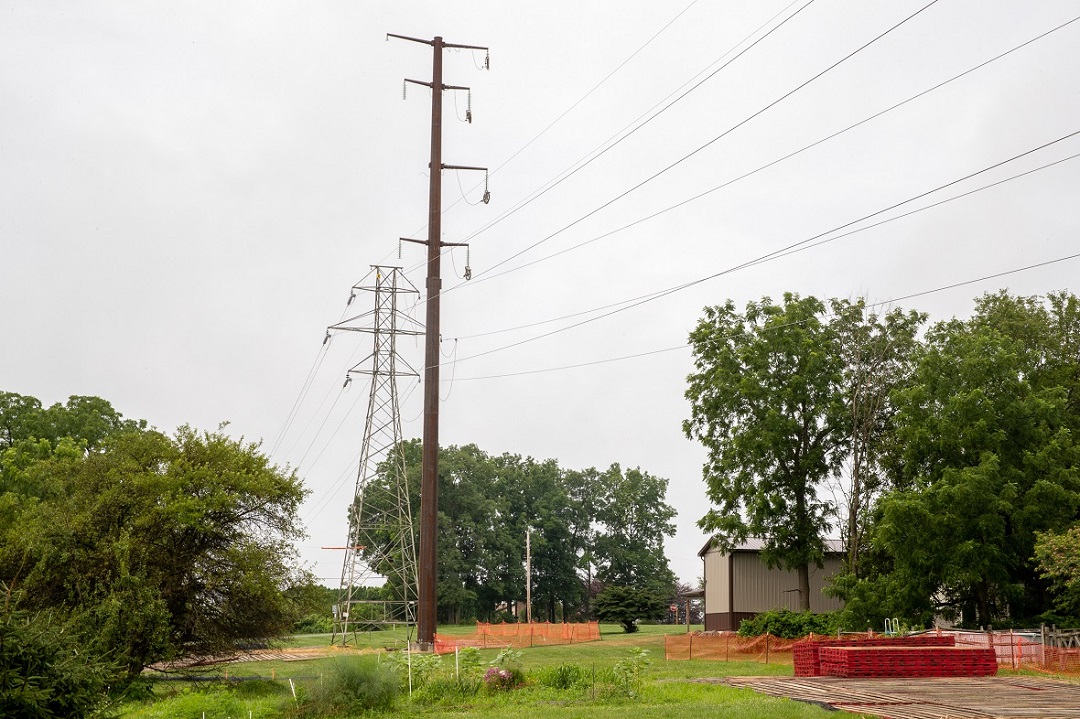
Our network of transmission lines (#2 below) plays an important role in supporting renewables. Just like our highway system, transmission is responsible for moving electricity quickly and safely over long distances. 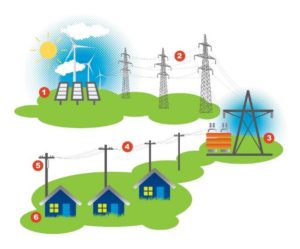
A cleaner energy future requires moving electricity to cities and other areas that need it. Transmission is critical in transporting renewable energy from where it is produced – often in remote, rural areas – to where it’s needed.
The sun doesn’t always shine, and wind doesn’t always blow. New technologies are needed on the transmission system to keep electricity flowing whenever power is needed.
We’ve taken steps to modernize and upgrade the transmission system to help prevent outages for customers, safeguard against cyber and physical attacks, and to support adding more renewables to the grid.
Sensors automatically identify problems on the grid, so power can be remotely rerouted to where it is needed, isolating the problem and quickly restoring power to customers.
We’re doing other things like using data analytics to signal when a piece of equipment needs to be replaced and identifying damaged or diseased trees– before they cause a power outage.
Preserving our transmission system is increasingly important to a safe and reliable power grid. With our innovation and advanced technology, we’ll be prepared.
To learn more about the important role of transmission, visit pplelectric.com/transmission.

Jun 29, 2020 | Customer Service
We deliver electricity to a wide range of residential and business customers throughout Pennsylvania. However, our large power customers, such as national and industrial accounts, have unique questions and issues that require personalized support. That’s why we have an outstanding team of Key Account Managers to offer the service they need.
Each of our Key Account Managers (KAMs) supports large businesses in one of eight regions across our territory. Not only do they serve as liaisons and advisors for coordinating major projects, they also provide solutions to various customer issues including emergency or planned outages, billing and metering questions, service projects and real estate. Ultimately, they’ll help you run your businesses safely, efficiently and successfully.
Here’s a list of our KAMs and the regions they support.

If you’re a mid-sized business in one of these regions, you’re also entitled to personalized support. Contact our Business Accounts team by emailing businessaccounts@pplweb.com or calling 1-888-220-9991 and selecting option 4 to discuss your account.
Lastly, we’re always here to support our entrepreneurs and small business customers. You can find resources by visiting our website or calling 1-800-342-5775.

Jun 11, 2020 | Safety and Security
We’re all getting used to a new normal with public health and safety on everyone’s minds. In some respects, we must be even more vigilant about safety these days. As businesses re-open and schools are dismissing, we wanted to share a few tips to help you enjoy summer safely.
Families are spending more time at home, in their gardens and yards, or in local parks for recreation – all places where ticks and other insects hide. Here’s how you can prevent tick bites or stings:
- Use insect repellents containing DEET on your skin
- Tape your pant legs and shirt sleeves
- Wear light colors so you can easily spot ticks on your clothing
- As soon as you return indoors, check your clothing and skin for ticks
As many of us continue to work from home to prevent the spread of the coronavirus, we’re using non-traditional spaces as offices. This lends itself to electrical hazards. Use these electrical safety tips to keep your home office safe:
- Inspect extension cords and chargers for frayed wires
- Avoid overloading outlets
- Do not run cords under carpets or rugs
- Make sure your cords are not tripping hazards for children or pets
Pools and lakes are very popular this time of year, but they can also be very dangerous. Follow these tips to stay safe when swimming:
- Never swim alone and don’t allow children to swim without supervision
- Always wear a lifejacket when you’re on a boat
- Watch for undertows in rivers and lakes – don’t underestimate the power of water
- Keep a first aid kit nearby
Lastly, as we bring in summer – the heat is sure to follow. Here’s some advice for keeping cool:
- Stay hydrated by drinking lots of water, even if you don’t feel thirsty
- Wear sunscreen to prevent sunburn
- Take time to rest and cool down indoors
- Use air conditioning if possible
For more summer safety, check out these tips from the National Safety Council.

May 27, 2020 | Safety and Security
Looks like 2020 is at it again. Weather scientists are predicting a more active than normal hurricane season this year. Even though we’re working a bit differently these days, we’ll be ready if any of those storms affect central and eastern Pennsylvania.
We want you to be ready too. Stay alert by tuning into local weather reports and check out our tips to prepare for severe weather.
When the National Oceanic and Atmospheric Administration (NOAA) released its hurricane season predictions on May 21, acting Administrator Neil Jacobs noted the upcoming season was no different than any other, in the sense that early planning and preparedness is essential. We couldn’t agree more.
NOAA predicted the likelihood of 13-19 named storms, 6-10 hurricanes and 3-6 major hurricanes (Category 3 or higher) this season, which officially runs from June 1 through November 30. What’s considered average? NOAA says a normal hurricane season will bring 12 named storms, 6 hurricanes and 3 major hurricanes.
The approaching warmer weather not only ushers in hurricane season, it’s also prime time for thunderstorms and other severe weather. However, our continued grid investments have reduced the impact of these storms. From 2011 to 2019, we reduced the annual number of customer interruptions by 30 percent. Since 2010, we’ve also reduced the overall frequency of these interruptions by nearly a third.
Our extensive use of smart grid technology helps us reduce outages, along with other things like replacing aging equipment with stronger, more storm-resistant poles and wires, comprehensive tree trimming, improved lightning protection, expanded use of animal guards, and more.
Strong storms like hurricanes will still produce some power outages, but no matter the circumstances, we’re prepared to work around the clock to get the lights back on. The pandemic may have us working differently, but we’re still delivering for our customers no matter what Mother Nature – or 2020 – throws at us.
Visit pplelectric.com/safety and pplelectric.com/outage for great information on how to stay safe before, during and after a storm.